
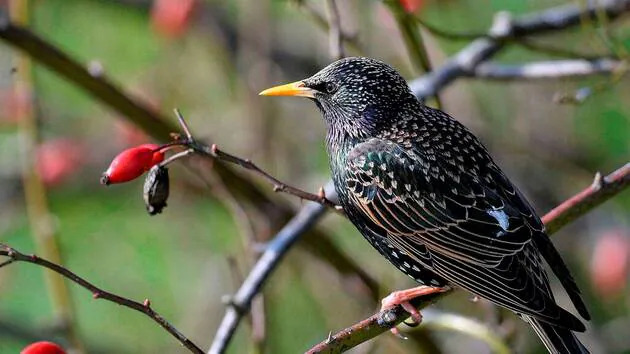
De tout ses termes insolites attribués à des groupes d’animaux, le mot le plus poétique est sans conteste attribué aux étourneaux, lorsqu’ils volent en très grand nombre dans le ciel, en virevoltant comme s’ils ne faisaient qu’un, ils forment un “murmure” ou une “murmuration”.
Le phénomène se produit dans toute l’Europe entre octobre et février, au crépuscule lorsque les oiseaux se rassemblent sur des sites de repos appropriés
En hiver, de nombreux oiseaux européens partent pour l’Afrique. Contrairement aux espèces migratrices, comme les martinets ou les hirondelles qui disparaissent complètement jusqu’en mars-avril, les étourneaux se rencontrent toute l’année en France. Entre octobre et février, des millions d’individus originaires du nord et de l’est de l’Europe viennent retrouver leurs congénères sous nos latitudes, où la température est plus douce. Se retrouvant alors par millions dans les régions au climat plus clément, ils étoffent les populations sédentaires pour se nourrir là où le sol n’est pas gelé. Ils repartent dans leurs contrées en février ou mars et seuls les oiseaux locaux restent.
Pour en savoir plus à lire >>>
Les Jardins de Mélusines: La murmuration, le vol magique des étourneaux
Article du National Geographic : Que font les oiseaux quand ils volent en nuée ?
In English:
The flocks of starlings or murmurations
Of all the unusual terms used to describe groups of animals, the most poetic is undoubtedly that of starlings. When they fly in very large numbers across the sky, swirling as if they were one, they create a “murmur” or “murmuration.”
This phenomenon occurs throughout Europe between October and February, at dusk when the birds gather at suitable roosting sites.
In winter, many European birds migrate to Africa. Unlike migratory species such as swifts or swallows, which disappear completely until March or April, starlings can be found year-round in France. Between October and February, millions of individuals from northern and eastern Europe join their kin in our latitudes, where the temperature is milder. Converging by the millions in regions with milder climates, they swell the ranks of resident populations to feed where the ground is not frozen. They return to their homelands in February or March, and only the local birds remain.
To learn more, read on >>>
The Gardens of Melusine: The Murmuration, the Magical Flight of Starlings
National Geographic Article: What Do Birds Do When They Fly in Flocks?
 Raphael Seygnovert, Artiste Peintre